Template Website vs Custom Development: What to Choose and How Much It Costs
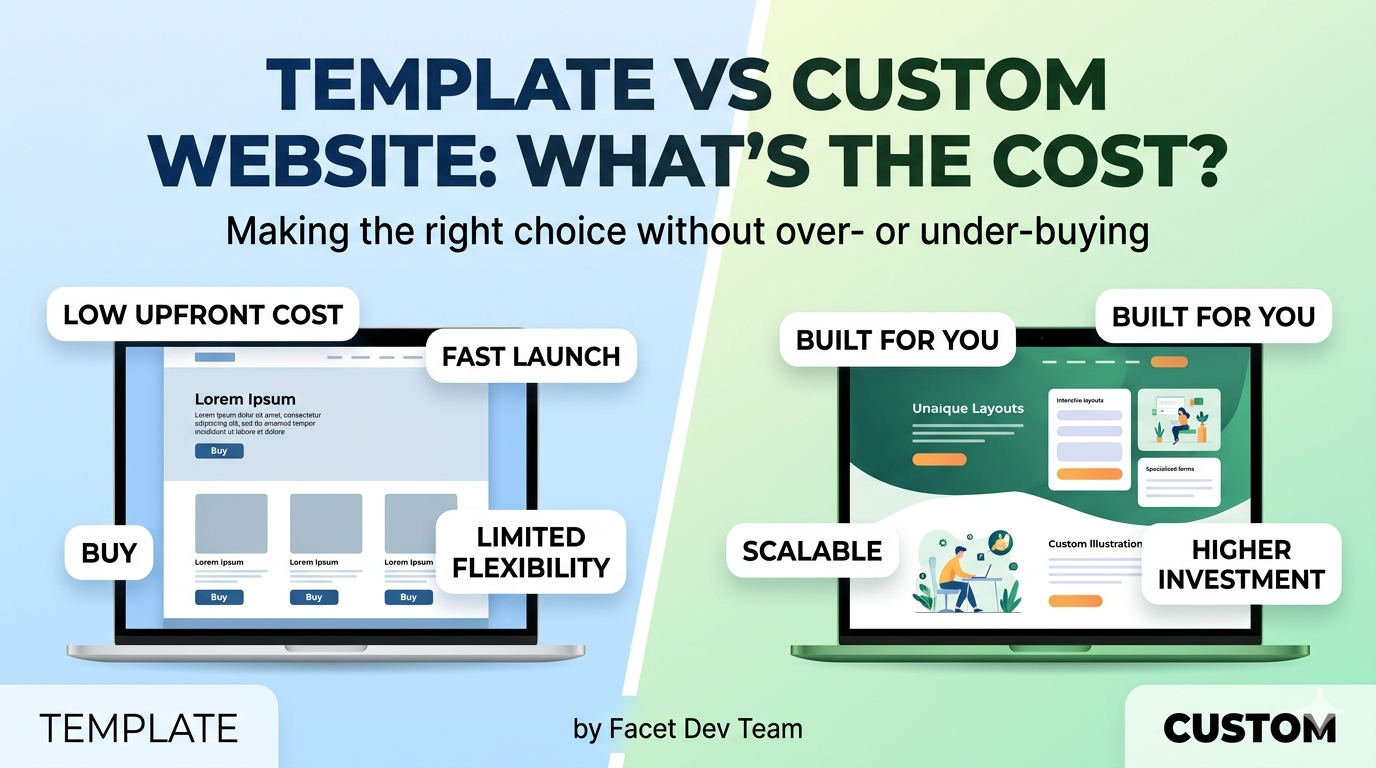
Template Website vs Custom Development: What to Choose and How Much It Costs
Introduction
Request three quotes and you might get $500, $10,000+, and a third vendor who will not name a figure until a discovery call. That gap is not a scam. It usually comes down to template website vs custom scope - and who is doing the work.
Below: what you are actually buying, how website development pricing is usually built, and how to match the approach to your stage without paying for the wrong thing.
In this article you will learn:
- What template and custom builds are, in plain terms
- Trade-offs of each path
- Realistic ranges for custom website cost and template projects - and what moves the number
- When to pick which, and mistakes that waste budget
What Is a Template Website?
A template website starts from a pre-built design and layout. Structure, typography, spacing, and navigation are largely decided for you. Your work is mostly configuration and content: logo, colors, copy, images, and shuffling sections within what the template allows.
Common examples:
- WordPress themes - pre-made layouts plus a content editor; standard for blogs and brochure sites
- Webflow templates - designer layouts you clone and adjust in Webflow
- Shopify themes - layouts built around catalog, cart, and checkout
How it works
You choose a template, set up hosting or the platform, swap in your content, connect the domain, and add plugins or apps for forms, basic SEO, analytics, and the like. A freelancer or small shop can move fast when you stay inside what the template was built for. The friction starts when you push past light customization - unusual layouts, custom data, or workflows the theme never anticipated. That is when timelines slip and costs climb, sometimes without fixing the underlying limit.
Pros of Template Websites
Fast to launch. A tight template build can ship in days or a couple of weeks, not months.
Lower upfront cost. You are not funding design and engineering from a blank page.
Solid for MVPs and simple sites. Credible presence, a lead form, and clear service pages are often enough to test the business.
Cons of Template Websites
Limited flexibility. Templates assume certain page types and content shapes. Need a workflow, layout, or data model the theme did not plan for? You fight the tool.
Hard to scale. More pages, locales, permissions, or editors often expose rigidity - workarounds, duplicate content, or a brittle plugin stack.
Performance limits. Heavy themes, plugin bloat, or dense page builders slow the site. That hits patience and search.
Familiar design. A “customized” template can still read as generic. Fine at early stage; a problem for some brands.
What Is Custom Website Development?
Custom website development means the experience is designed and built for your business: information architecture, visual design, front-end code, and often tailored back-end logic, integrations, and admin workflows. You are not inheriting a generic theme’s assumptions - beyond the core stack or CMS.
The site follows your offers, your conversion paths, and your operations - not the reverse.
Pros of Custom Development
Full flexibility. Layouts and features follow how you sell and support - not a template author’s guess.
Scalable architecture. Room for more content, locales, products, or internal users without a yearly rebuild.
Better performance. Lean, purpose-built front ends and disciplined integrations usually beat a kitchen-sink theme - if the team cares about speed.
Distinctive brand. Design and interaction that support trust and recall in crowded markets.
Cons of Custom Development
Higher cost. Design, build, QA, and often maintenance all show up in custom website cost.
Longer timeline. Discovery, design rounds, build, and testing need real time. Rushing creates expensive rework.
Needs a strong team. Custom work exposes vague specs and weak process fast. You want people who can define, ship, and support the product.
Pricing Breakdown
Ballpark figures for small to mid-sized business sites in typical US and Western European markets. Your website development pricing still hinges on scope, polish, and who you hire.
Same headline numbers can hide very different teams. Rates and totals shift with seniority (junior vs lead-heavy), geography (local agency vs distributed), and process (discovery, QA, documentation, post-launch support). A higher quote sometimes buys fewer surprises; a low one sometimes means narrow scope - verify what is included.
| Approach | Typical range (USD) | What you are usually buying |
|---|---|---|
| Template website | $500 – $3,000 | Theme or template, setup, basic customization, content placement, essential plugins or apps, launch support |
| Advanced template / heavily customized template | $3,000 – $8,000 | Deeper visual work, more pages, custom sections within platform limits, more integrations, SEO setup, training |
| Fully custom website | $8,000 – $30,000+ | Custom UX/UI, bespoke front end, CMS or app setup for your workflows, integrations, performance work, QA, documentation |
$30,000+ is common when you add serious auth, customer portals, multi-language editorial workflows, heavy third-party systems, or product-style iteration.
What affects price
- Page count - More templates, content entry, QA.
- Custom features - Calculators, configurators, gated content, memberships, booking - anything beyond static copy.
- Integrations - CRM, marketing automation, ERP, payments, SSO - each needs discovery, build, and handling of edge cases.
- Design depth - Illustration, motion, strict brand systems cost more than a clean corporate layout.
- Content - Copy, photography, and video are often billed separately; budget them in the same conversation.
Template website vs custom is largely commoditized setup vs bespoke product work. That gap drives the difference between low thousands and high tens of thousands.
Typical Timelines
Calendar time is not the same as “effort,” but it shapes launches and cash flow.
- Template website: 3–14 days for a focused build when content is ready and scope stays standard.
- Advanced template / heavily customized: 2–6 weeks once you add more pages, deeper styling, integrations, and review cycles.
- Custom website: 6–16+ weeks for discovery, design, build, and QA; complex products or large teams on your side often push past the high end.
Rush fees, slow approvals, or late content always add weeks - regardless of path.
When to Choose Each Option
Choose a template if…
- You need the site live soon on a tight budget
- You are mostly marketing pages, a blog, or a standard storefront
- You are testing an offer and can live with some design sameness
- You are willing to revisit the build after you prove demand
Choose custom development if…
- Brand and experience are core differentiators
- You have non-standard content, workflows, or data to present clearly
- You expect real growth in pages, markets, or features
- Performance, accessibility, and SEO are strategic priorities
- You want one coherent system, not a growing pile of plugins and patches
A path that works in the real world: Launch on a strong template with a tight scope, learn what converts, then invest in a custom rebuild when requirements and revenue justify it. The expensive mistake is the reverse - full custom before you know what users actually respond to.
Common Mistakes to Avoid
Chasing the lowest quote without reading scope. Cheap often means thin revisions, minimal testing, or an overloaded solo operator. Confirm what is covered: rounds of feedback, mobile QA, analytics, backups, post-launch fixes.
Ignoring scalability. If you already know you need multiple languages, a large resource library, or a partner portal, a template that “mostly works” today can force a costly migration later.
Overbuilding too early. All-custom everything before product–market fit burns budget on unproven features. A template now and custom later is sometimes the rational sequence.
Conclusion
Website development pricing varies because the work is not interchangeable - a template implementation is not the same job as a tailored product. Framing template website vs custom clearly helps you buy the right level: fast template launch now, or custom website cost that buys fit, performance, and a system aligned with how you run the business.
Summary: Templates win on speed and upfront spend; custom wins on fit, scale, and differentiation. Match the build to your stage; increase investment when the case is obvious.
Tell us your goals, target timeline, and rough budget range - even a bracket helps. We will tell you honestly if a template, a hybrid, or full custom makes sense, and what we would scope for the price. No pressure for a “sales call”: we treat it as advisory first. Get in touch or request a quote.